Exam Question: Analyse the use of media language to create meaning in the online Observer home page
There are a lot of different examples of use of media language in the front page of the Observer. Firstly the Observer categorises the different articles like features, sport and interviews. This will draw the reader to what type of articles they want to look at, meaning they are more likely to look at articles, especially ones they like, instead of having to search for particular ones, this also meaning that it will attract a larger range of readers.
The article also enlarges certain articles to give them more attention and meaning. For example one of the larger articles is 'can I forgive the man who raped me?'. This is very intriguing because there is no further back story, and it is just a simple question which will make the readers want to know the answer.
They also make the headings, short, simple and catchy, so it is possible for reader's to browse through and search for particular ones that interest them. One heading is 'my lifelong affair with photography'. This title is catchy because it will leave the reader with their own questions like why is this mans relationship with photography an affair, and so what else does he have going on in his life?
A final way in which this front page uses language to create meaning is the use of quotes. These quotes are generally peoples opinion, and so you may have your own opinion on the matter, whether you disagree with it or agree you will want to read it for you want to hear someone else's opinion.
Saturday, 27 January 2018

Thursday, 25 January 2018
Enigma review
We decided to use a box as our main prop and create a short film about it. We started by discussing our ideas for what we could use the box or any other props for. We decided to do a short sketch on how a box is delivered to to men. However, they do not know the contents of this box. Then as it turns out there is a head in this box. We started by filming the delivery man, wearing a wig, deliver a parcel. Then the two men investigate the box before opening it. To create the head in the box effect we cut a hole in the bottom of the box and had someone stick their head though and then surrounded the head in bubble wrap to hide the hole and only show the head. We then filmed a final scene where you see the delivery person without the wig, as it was supposedly a disguise looking through a door. Therefore, leaving it on an enigma.
Wednesday, 24 January 2018

Sunday, 21 January 2018

Thursday, 18 January 2018

Sunday, 7 January 2018
Genre codes in The Lego Movie posters
Exam question: Analyse how genre codes have been used in The Lego Movie poster campaign to appeal to a family audience. (10 marks)
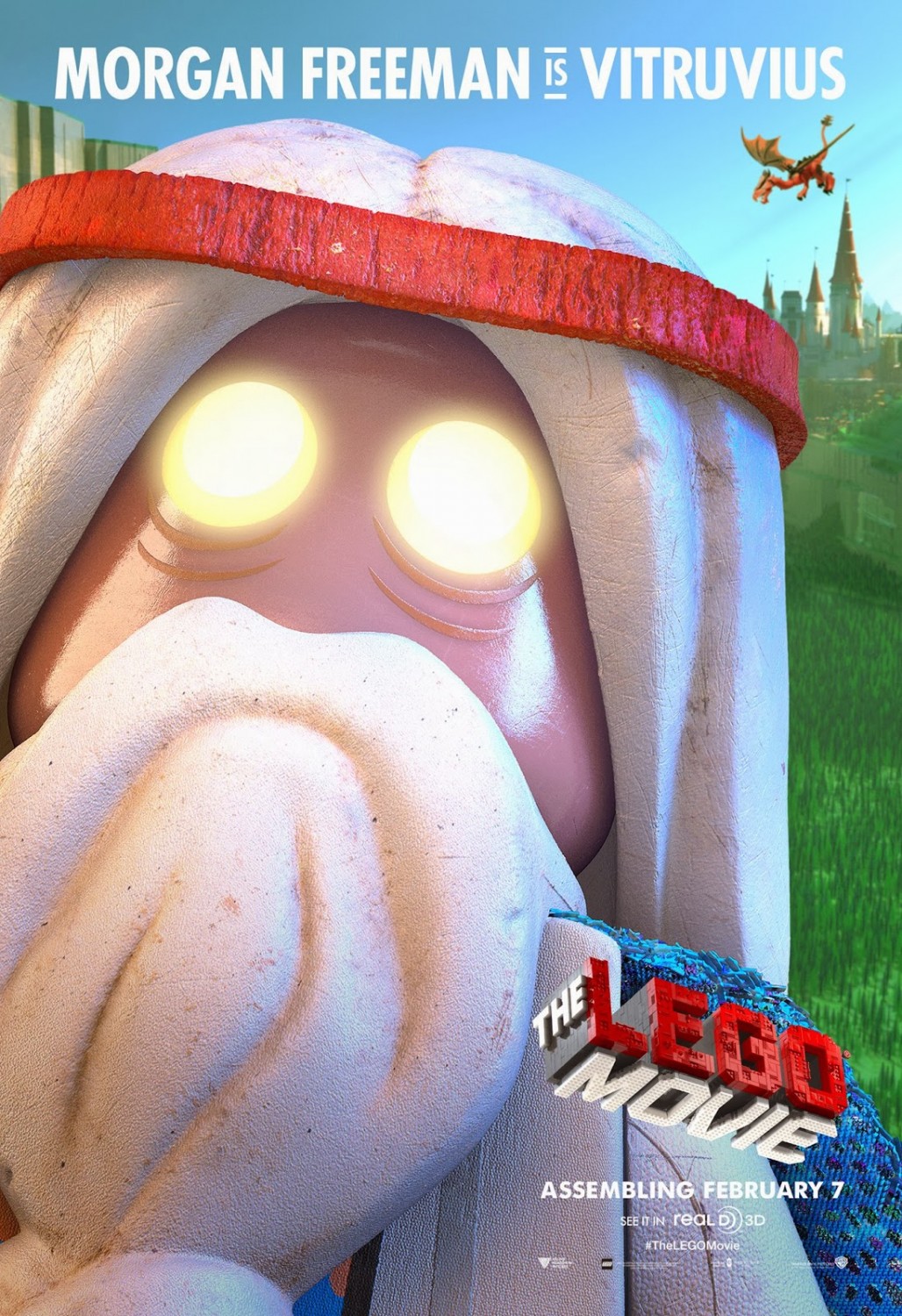
This is a poster of one of the main characters in the film. The first thing that most people would acknowledge when they look at this is the large close up of the character taking up most of the screen. This sort of character due to his parcticular traditional appearance, is recognised, generally as an old and wise person, who is usually a wizard. He is recognised as this due to things like his white and long grey hair and beard, with a white robe and glowing, mystical eyes. This is relating to other popular movies like Harry Potter and The Lord of the Rings, who both have similar characters to this. Something else that viewers will instantly be drawn to is who is playing this particular character which is written in bold across the top. The actor is Morgan Freeman who is a very well known actor, who has been acting for many years. So there is a possibility that as well as attracting younger people older people who might know him more well may become interested. This poster also shows a background of a Lego world with a dragon and a castle which would be intriguing towards the viewer who would like to see how the character and the background correlate. Lego is also a very well known brand which would make people who use Lego even more interested in seeing the film.

This is a poster of possibly the main character which the story focuses on. The audience can relate to this character for he is an ordinary 'everyman', like the rest of us. The fact that he is ordinary is emphasised by the fact that he is wearing construction clothes and is on a construction site, showing he has a job an ordinary person would have. There is an explosion in the background of this photo and following Emmet's expression, you can tell he is not used to these kind of extraordinary things happening to him seeing as he is just a normal person, sending the message that this kind of thing could happen to you. His expression also gives a humorous aspect of the poster. Viewers would also be attracted by the tagline of the Lego Movie which is 'a nobody who saved everybody', which seeing as the role Emmet plays, similar to people going about their ordinary lives, will make people interested seeing as it could be something that they could do. Chris Pratt, who plays the role of Emmet is also a very well known actor, following starring in programs like Parks and Recreation, which is a comedy program so viewers might be able to guess that there is some comedy involved. It also announces the date it is being released by using the word 'assembled', which is a play on word to the fact that there is construction in the background and that you 'assemble' Lego.
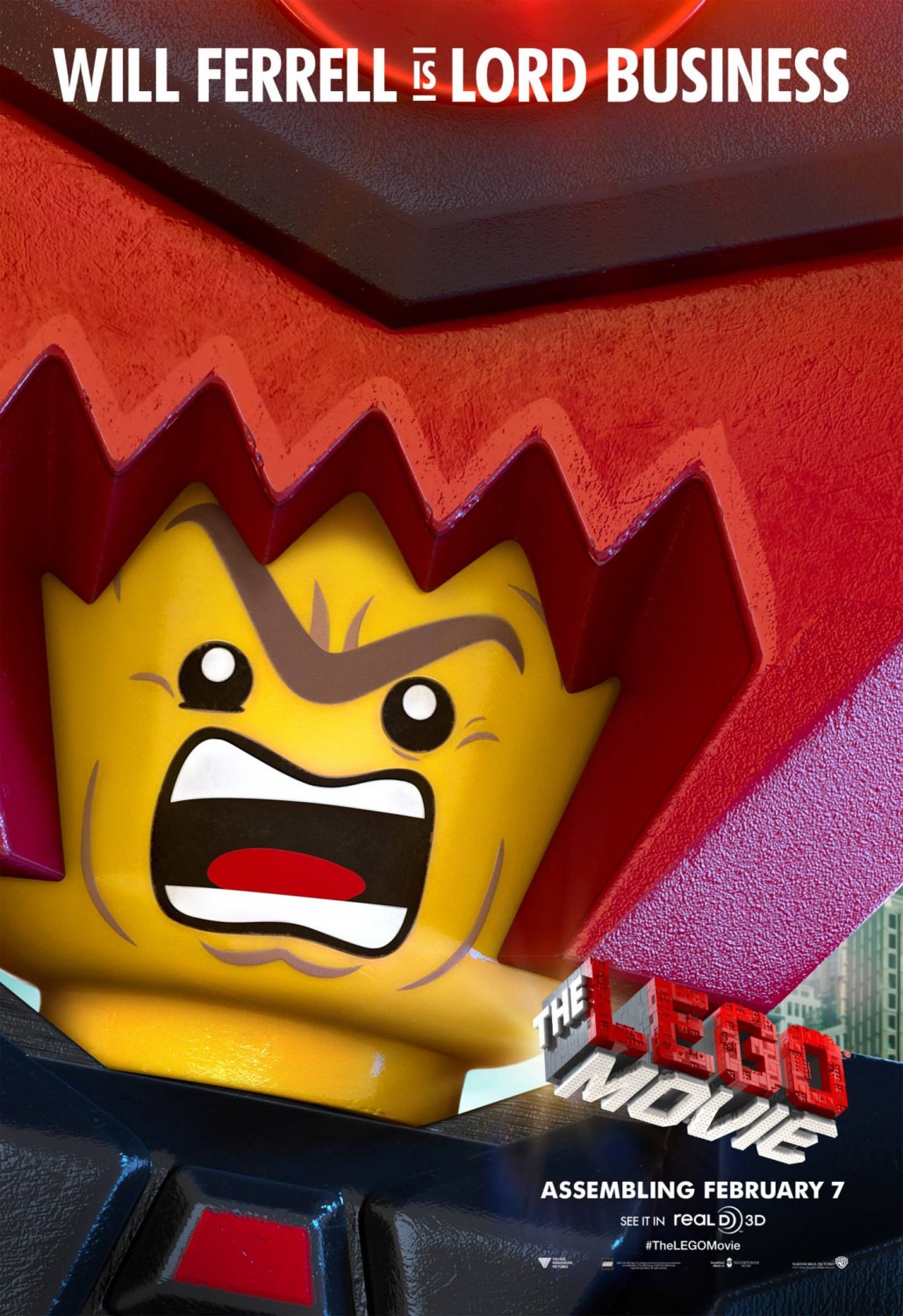
This is a poster of a character who is very obviously the antagonist due to his particular appearance. He has a an angry look on his face which is exaggerated by his mono-brow to help frame his face. He is also stereotyped as a villain because of his large helmet, that is red, which is a colour usually associated with something bad. The helmet also has a rim which are shaped like sharp teeth. This character is played by Will Ferrell, who is very well known for playing comedic roles. This will make the audience interested in why he is playing a villain, and the irony of it. Which also hints at comedic essence's.

This is another of the main character's, who helps along with Emmet's story. She is portrayed as a young, strong, independent women, who throughout the film is seen breaking many gender stereotypes, which would allure a lot of women who would see her as a sort of role model. She is also portrayed as rebellious and stands out due to the brightly coloured, eccentric streaks in her hair, and also that she is being chased by people in the background. But still stares lavishly and boldly at the camera as if she is used to it and it doesn't bother her. She is played by the actor Elizabeth Banks, who is once again a very familiar actor, who plays a lot of characters which are very similar to the feel of this film. Which means that people who like her other films may be interested in this one.
This is a poster of one of the main characters in the film. The first thing that most people would acknowledge when they look at this is the large close up of the character taking up most of the screen. This sort of character due to his parcticular traditional appearance, is recognised, generally as an old and wise person, who is usually a wizard. He is recognised as this due to things like his white and long grey hair and beard, with a white robe and glowing, mystical eyes. This is relating to other popular movies like Harry Potter and The Lord of the Rings, who both have similar characters to this. Something else that viewers will instantly be drawn to is who is playing this particular character which is written in bold across the top. The actor is Morgan Freeman who is a very well known actor, who has been acting for many years. So there is a possibility that as well as attracting younger people older people who might know him more well may become interested. This poster also shows a background of a Lego world with a dragon and a castle which would be intriguing towards the viewer who would like to see how the character and the background correlate. Lego is also a very well known brand which would make people who use Lego even more interested in seeing the film.
This is a poster of possibly the main character which the story focuses on. The audience can relate to this character for he is an ordinary 'everyman', like the rest of us. The fact that he is ordinary is emphasised by the fact that he is wearing construction clothes and is on a construction site, showing he has a job an ordinary person would have. There is an explosion in the background of this photo and following Emmet's expression, you can tell he is not used to these kind of extraordinary things happening to him seeing as he is just a normal person, sending the message that this kind of thing could happen to you. His expression also gives a humorous aspect of the poster. Viewers would also be attracted by the tagline of the Lego Movie which is 'a nobody who saved everybody', which seeing as the role Emmet plays, similar to people going about their ordinary lives, will make people interested seeing as it could be something that they could do. Chris Pratt, who plays the role of Emmet is also a very well known actor, following starring in programs like Parks and Recreation, which is a comedy program so viewers might be able to guess that there is some comedy involved. It also announces the date it is being released by using the word 'assembled', which is a play on word to the fact that there is construction in the background and that you 'assemble' Lego.
This is a poster of a character who is very obviously the antagonist due to his particular appearance. He has a an angry look on his face which is exaggerated by his mono-brow to help frame his face. He is also stereotyped as a villain because of his large helmet, that is red, which is a colour usually associated with something bad. The helmet also has a rim which are shaped like sharp teeth. This character is played by Will Ferrell, who is very well known for playing comedic roles. This will make the audience interested in why he is playing a villain, and the irony of it. Which also hints at comedic essence's.
This is another of the main character's, who helps along with Emmet's story. She is portrayed as a young, strong, independent women, who throughout the film is seen breaking many gender stereotypes, which would allure a lot of women who would see her as a sort of role model. She is also portrayed as rebellious and stands out due to the brightly coloured, eccentric streaks in her hair, and also that she is being chased by people in the background. But still stares lavishly and boldly at the camera as if she is used to it and it doesn't bother her. She is played by the actor Elizabeth Banks, who is once again a very familiar actor, who plays a lot of characters which are very similar to the feel of this film. Which means that people who like her other films may be interested in this one.
Friday, 1 December 2017
Contrasts in magazine covers
PREP: Analyse the media language of the MOJO cover below. Use the terms that you have learned.
Compare and contrast the cover with another magazine cover, drawing attention to the similarities and differences, and saying what the genre codes and conventions are.


Compare and contrast the cover with another magazine cover, drawing attention to the similarities and differences, and saying what the genre codes and conventions are.
These are both covers of well-known music magazines, MOJO and Q. MOJO presents David Bowie as the main splash, he is the main centre of focus and is seen standing tall and confident. He has his hands behind his back as if saying he needs no defence and he is gazing at the camera with his chin slightly lowered, showing no one has any authority over him. He is wearing smart but casual clothes, a plaid t-shirt with a tie with the same pattern on it as if to blend in and is wearing a light blue blazer/jacket along with jeans and heavy boots. All of this is presented in a way that is smart, as if for the occasion, but also classy and casual. The other things on this cover all are important but do not draw away too much from the main photo, the first thing that you notice when you see this is 'Bowie' and the photo of him. There is also a lot of negative space as to not make it appear too clustered.
Similar to the other there is also one large main splash which in this case is Ed Sheeran. He is shown as being sort of 'puppy like', , someone that we all love and adore, especially with his affectionate, large, enhanced blue eyes. However, despite this he features are quite defined as to not seem too vulnerable. He is wearing casual dark leather clothes which partially blend in with the negative space around him while his face and guitar have strong lighting on them, for this is where the meaning is held in this photo. There is a lot less negative space in this but it still does not appear clustered for it is well organised and the fact that that everything other then Ed Sheeran himself have simple contrasting colours, which also helps your eyes not be too drawn away from the main splash but to also notice them.
Similarities in these two magazines include that they both have one large, main center of focus that is an image, with their upper-body, both overlapping any text or photos that are there, and large, bold writing of their name across their chest. Also, both are very well known and quite influential artists. Both have set colour schemes (e.g MOJO, blue, yellow and white; Q, red, white and black). They both have cover lines which briefly say what is featured inside the magazine.
Differences between the two include that in the MOJO magazine it is mainly focused on Bowie's upper-body, clothes and face, where as in the Q magazine it is focused on his face and instrument and as little as possible notice is placed on the clothes which are black and blend in. Bowie gives off more of a confident tall, chest protruding, stern look, but Ed Sheeran looks smaller and more caring and more sympathetic. The MOJO magazine appears to be a tribute dead artists with Bowie as the main figure but the Q magazine is about the story's of artists.
Wednesday, 22 November 2017
02 MUSIC: MOJO COVER 2017
'How representations on magazine covers reflect the social and cultural contexts in which they were produced'.
The magazine is loved by its readers and artists alike because it engages them on the subject they love the most: music itself.
Every month MOJO releases a definitive cover feature on an iconic act; a bespoke CD (especially compiled by the editorial team or a major musician in MOJO’s world); and our famous reviews section, the Filter, which brings you 30 pages-plus of the best of that month’s music, both classic and contemporary.
MOJO is the world's largest UK music magazine, delivering a monthly dose of world class journalism and iconic photography to an audience of extremely passionate music consumers. If you’re featured in MOJO, you matter.
MOJO is the music expert – a magazine of high brand values and integrity. A carefully crafted musical archive covering the very best of music across genres. From classic and modern rock, folk, soul, country to reggae, electronic and experimental. It prefers to celebrate quality over popularity – music that will stand the test of time.
The Sex Pistols
1. The Sex pistols were an English punk rock band formed in London in 197. They are described as one of the most influential acts in the history of popular music. They had very strong opinions about various things They initiated the punk movement in the UK.
The magazine is loved by its readers and artists alike because it engages them on the subject they love the most: music itself.
Every month MOJO releases a definitive cover feature on an iconic act; a bespoke CD (especially compiled by the editorial team or a major musician in MOJO’s world); and our famous reviews section, the Filter, which brings you 30 pages-plus of the best of that month’s music, both classic and contemporary.
MOJO is the world's largest UK music magazine, delivering a monthly dose of world class journalism and iconic photography to an audience of extremely passionate music consumers. If you’re featured in MOJO, you matter.
MOJO is the music expert – a magazine of high brand values and integrity. A carefully crafted musical archive covering the very best of music across genres. From classic and modern rock, folk, soul, country to reggae, electronic and experimental. It prefers to celebrate quality over popularity – music that will stand the test of time.
The Sex Pistols
1. The Sex pistols were an English punk rock band formed in London in 197. They are described as one of the most influential acts in the history of popular music. They had very strong opinions about various things They initiated the punk movement in the UK.
Saturday, 11 November 2017
Music Video Codes and Conventions
PREP MUSIC VIDEO CODES AND CONVENTIONS
To prepare for the exam, we look at the media language of music videos, such as their codes and conventions below. For prep, copy the points in colour then add your own points in black.
To prepare for the exam, we look at the media language of music videos, such as their codes and conventions below. For prep, copy the points in colour then add your own points in black.
- Performance - the singer / band are seen to be singing and playing (including lip synching), to provide authenticity, so that followers believe in the talent and can see their star. Record labels sign stars and promote them to ensure sales.
- Star - use of close-ups, sometimes direct eye contact with audience, to build relationship with audience.
- The visuals (what the star and other characters are seen doing) illustrate, amplify or contradict the lyrics (the 'story in the words'). Illustration = the visuals play out the story more or less literally; amplify = the words in the lyrics are only the starting point and the story develops in other directions; contradiction / disjuncture = the visuals do not interpret the words of the lyrics and may even show something contradictory.
- The narrative usually features the performer in 'real life' situations but often with experimental types of film making such as hand-held, dramatic camera angles, symbolic codes and lighting
- The visuals are usually cut to the beat of the music; the editing is often fast-paced; there is often use of montage, ellipsis and intercutting, stylish effects.
- Refrain - repeated chorus, sometimes with variations
1. Avril Lavigne sings throughout the video using a mike and draws a huge crowd of fans around her when she jumps onto a car roof in the street. She sings with great passion, energy and conviction, holding the mike close to her mouth. Close-ups show her every word (lip synching is a feature of music videos.) She performs for her fans and for her 'boyfriend' the sk8er boi who features in the narrative. Screens often feature in music video and the sk8er boi is videoing Avril Lavigne as he gazes adoringly up at her. She returns his gaze as she sings about 'we rock each other's world'. The performance element creates authenticity (fans have proof of her talent) because we see her sing.
2. Avril is presented to the audience with a lot of attitude which shows during aspects like the close ups of her. She is shown as cocky, brash and self-confident. She is telling a story and her actions and contact with the camera hint at us that really she is right and the one with power. She invites us into her life and makes us believe the story she is telling and makes us believe that it is happening to her and presents it in the way that she is the hero and we should have no sympathy for the other women, which you believe because she is creating a one on one connection with the audience.
3. One narrative thread that dominates the entire video is the star symbol which marks their gangs territory. Essentially it is representing Avril, it is everywhere usually in the background giving the implication that she is everywhere or her presence is. This is all about her life and the way she does things and how she is a perfect match for the 'Sk8er Boi' and the other girl is the complete opposite and didn't understand him so clearly she doesn't deserve him. You see her boasting that she is the one with all the independance with a gang that follows her around everywhere and adores her while the other is sitting at home alone with a baby.
4. There a lot of hand held camera shots in this for example when they are all in a car and it is being filmed the camera shakes a lot like the person carrying it is running. There also close ups of both of the lovers, Avril and the Sk8er Boi, gazing into each others eyes, they are in love and wrote this song together proving that they were meant to be together, complimented with the lyrics of the video.
5. The opening montages and are very fast setting the editing pace at that very fast pace, it is cut to the beat of the percussion, while Avril's gang mark their territory. The cutting shots and the actions on screen are fast paced because the music is like when Avril punches at the camera in time with the music and adds to the frantics in the scenes shown.
6. During the refrain the pace and visuals increase as you see her and her gang setting up the concert in rapid montage and also as the crowd start to pour in filling everywhere up as the chaos starts. This refrain is a repeated chorus but is more dramatic than the first as it builds up to a final conclusion before the police arrive.
Thursday, 9 November 2017
Editing, sound and camera work in Music Videos
Avril Lavigne's 'Sk8er Boi' is about a girl who rejected a man, even though she secretly wanted him, who is now famous and with the person who is signing in the video. The video starts with a focus shot on a pile of empty spray paint can and uses diagetic sound. Directly after this a man slides down on a harness and there is a sudden slightly shaky cam looking up to what he had just spray painted on the side of a building. This is the calm build up to the actual start of the song which is loud and upbeat. This song mainly consists of action and non-stop moving for once the music starts there are immediately loads of shaking shots and there are a lot of shots which move back and forth and also ones that are constantly moving in and out. These are all to imply more movement and action within the video to match the pace of it.
The shots in this video mainly consist of shots extreme close ups mainly towards the signer including face shots and and body shots including the hand mainly showing off her features like make-up, rings and arm cuffs. All of which further empahsise and create the atmosphere of the video. The sound in this video is all non-diagetic sound apart from the opening which uses diagetic sound as a background noise before the clanking of the can on the ground. The editing in this video consists of mainly direct cuts which are ususally in time with the music and are always direct cuts because others would be too slow and would not match the pace of the music. This get's you more into the mood of the music especially when what your watching correlates with it.
The shots in this video mainly consist of shots extreme close ups mainly towards the signer including face shots and and body shots including the hand mainly showing off her features like make-up, rings and arm cuffs. All of which further empahsise and create the atmosphere of the video. The sound in this video is all non-diagetic sound apart from the opening which uses diagetic sound as a background noise before the clanking of the can on the ground. The editing in this video consists of mainly direct cuts which are ususally in time with the music and are always direct cuts because others would be too slow and would not match the pace of the music. This get's you more into the mood of the music especially when what your watching correlates with it.
Monday, 6 November 2017
Editing Question
PREP Analyse how editing is used in the extract from Cuffs to create meaning. Refer to at least two examples from the extract in your answer. (This means that a good candidate will write fully and freely, covering more than just 2 examples, as we practised in class).
Worth 5 marks: write half a side of A4 and post on your blog tonight. If you have DoE, take an extra 24 hours.
A first scene where the editing is used to create meaning is in the scene where they are raiding the criminal suspect's home. When they enter they enter the house and start the fighting starts everything is suddenly thrust into chaos. Everything turns to slow motion, and all of the sounds become muffled this representing what Jake sees in his head, this being the first time he's been in a situation like this. After Jo shouts his name he suddenly comes back to his senses all the sound quickly rushes back in bringing him back to reality.
Another example is in the scene where Felix is watching the recording of the dad and his daughter or a screen analysing it. The edit in this scene has swapping shots from Felix and the screen while all the while also closing in on them framing them. It shows the dawning realisation of something on the detectives face and then gives a point of view shot of the TV as he plays it back, and then another face shot of the detective as he concludes what he saw this being shown by the zoomed in expressions on his face. It then shows a last frame which holds for a while of the hotel sign showing us what he was so intrigued and riveted by, after holding the suspense for the previous parts of the scene.
Some examples of shot reverse shock include the scene where DI Felix Kane is explaining to the mum that they had, had the father and the child but had then lost him. There are midshots between the mother who is in despair and disbelief and also while Felix looks rather embarrassed and won't look her directly in the eye. He blinks and looks down. It shows her yearning and his embarrassment and awkwardness. Another example of this technique is after Felix realises where the father is and goes to the hotel and confronts him while he is standing preparing to jump off of the hotel balcony. The shot reverse shot in this scene shows how agonised the fsther is after he realises what he has done knowing that there isn't really any way out of it. It then switches to Felix who mostly just stares at him intently not making any sudden moves or speaking, not wanting to make the incorrect move and have a life at stake. There is then a shot revere shot of the father's hand shaking as he prepares to jump off to the girl, showing them and the audience what is at stake.
In one of the final scenes in this episode it shows all of them training in the car parking lot. They are running back and forth and it gives cross dissolve transitions, to imply that time has passed showing that it lasted a long time and that they are getting more tired and exhausted to make us believe that they had actually been exercising.
Directly after this scene the Lawyer Simon Reddington approaches Jake and it shows face shots of both of them looking quite pleased, then cutting to a close shot of Simon slipping a piece of paper into Jake's revealed chest. It then shows the Porche driving away and to Jake still looking pleased at what happened, the camera lingers on him to show his flushed reaction as he smiles and blinks a lot.
There is then a final scene at the end of the episode which starts with Jake showering after the day he had just faced the warm non-diagetic sound of the warm shower running reflecting his emotions as he washes off all the impurities of the day and focuses on the good things, it's as if giving the audience a chance to breath and relax knowing the action is over. It then turns to a montage of the different characters giving this as the slow release at the end of the show.
Worth 5 marks: write half a side of A4 and post on your blog tonight. If you have DoE, take an extra 24 hours.
A first scene where the editing is used to create meaning is in the scene where they are raiding the criminal suspect's home. When they enter they enter the house and start the fighting starts everything is suddenly thrust into chaos. Everything turns to slow motion, and all of the sounds become muffled this representing what Jake sees in his head, this being the first time he's been in a situation like this. After Jo shouts his name he suddenly comes back to his senses all the sound quickly rushes back in bringing him back to reality.
Another example is in the scene where Felix is watching the recording of the dad and his daughter or a screen analysing it. The edit in this scene has swapping shots from Felix and the screen while all the while also closing in on them framing them. It shows the dawning realisation of something on the detectives face and then gives a point of view shot of the TV as he plays it back, and then another face shot of the detective as he concludes what he saw this being shown by the zoomed in expressions on his face. It then shows a last frame which holds for a while of the hotel sign showing us what he was so intrigued and riveted by, after holding the suspense for the previous parts of the scene.
Some examples of shot reverse shock include the scene where DI Felix Kane is explaining to the mum that they had, had the father and the child but had then lost him. There are midshots between the mother who is in despair and disbelief and also while Felix looks rather embarrassed and won't look her directly in the eye. He blinks and looks down. It shows her yearning and his embarrassment and awkwardness. Another example of this technique is after Felix realises where the father is and goes to the hotel and confronts him while he is standing preparing to jump off of the hotel balcony. The shot reverse shot in this scene shows how agonised the fsther is after he realises what he has done knowing that there isn't really any way out of it. It then switches to Felix who mostly just stares at him intently not making any sudden moves or speaking, not wanting to make the incorrect move and have a life at stake. There is then a shot revere shot of the father's hand shaking as he prepares to jump off to the girl, showing them and the audience what is at stake.
In one of the final scenes in this episode it shows all of them training in the car parking lot. They are running back and forth and it gives cross dissolve transitions, to imply that time has passed showing that it lasted a long time and that they are getting more tired and exhausted to make us believe that they had actually been exercising.
Directly after this scene the Lawyer Simon Reddington approaches Jake and it shows face shots of both of them looking quite pleased, then cutting to a close shot of Simon slipping a piece of paper into Jake's revealed chest. It then shows the Porche driving away and to Jake still looking pleased at what happened, the camera lingers on him to show his flushed reaction as he smiles and blinks a lot.
There is then a final scene at the end of the episode which starts with Jake showering after the day he had just faced the warm non-diagetic sound of the warm shower running reflecting his emotions as he washes off all the impurities of the day and focuses on the good things, it's as if giving the audience a chance to breath and relax knowing the action is over. It then turns to a montage of the different characters giving this as the slow release at the end of the show.
Thursday, 2 November 2017
Mise-En-Scene
PREP Analyse how mise-en-scene is used in the extract from Cuffs to create meaning. Refer to at least two examples from the extract in your answer. (This means that a good candidate will write fully and freely, covering more than just 2 examples, as we practised in class).
Worth 5 marks: write half a side of A4 and post on your blog tonight.
A first example of when mise-en-scene is used is in the opening scene when the chief superintendent is giving a speech. You can see the salience of this scene through many ways like the formal location they are using, the chief is standing on a raised podium. There is shot which is outside of the room looking in where it shows a sign saying 'suite' which shows that this is a ceremonial event and therefore largely important. The clothes that are worn in this scene further emphasise the importance of the meeting for they are all wearing suits and ties with their police helmets on and they are wearing white gloves which you would not really wear unless its a very formal occasion. Also the way some people hold their hands together in front of them, submissively shows that the chief is someone of significance.
Another scene, also at the beginning is on the beach when the officer is walking to the fight scene where the nudists and the criminals in this scene are fighting. The criminals are carrying a lot of props like wearing viking helmets and carrying plastic swords and also beer bottles, this shows that they are obviously drunk and aren't that serious. The fact that they are also wearing football shirts refers to the stereotype of people who enjoy that sport: inappropriate, quite vicious and mock people who are unaccustomed to themselves. The nudists are covered by nothing but towels, which they use to cover themselves when the officer arrives almost as if they are embarrassed by it for they are getting to much attention, at it also gives a large effect of humour especially contrasted with the voice over of the chief and his powerful speech about police respect.
In a scene where a drug addict has been self-harming. Firstly the man is completely scruffy and wearing old torn clothes with greasy hair and covered in dirt and blood, this shows that this man has no sense of self-pride and has basically lost all of it, also shown with the way he points the knife at the officers while his hand is shaking. Later on in the scene there is a wide shot of his entire living room which is shown in quite a dark filter and like him is also messy and littered in beer bottles, plastic bags old food waste and dying plants, all of this emphasising how depressing and calamitous this particular scene is.
Worth 5 marks: write half a side of A4 and post on your blog tonight.
A first example of when mise-en-scene is used is in the opening scene when the chief superintendent is giving a speech. You can see the salience of this scene through many ways like the formal location they are using, the chief is standing on a raised podium. There is shot which is outside of the room looking in where it shows a sign saying 'suite' which shows that this is a ceremonial event and therefore largely important. The clothes that are worn in this scene further emphasise the importance of the meeting for they are all wearing suits and ties with their police helmets on and they are wearing white gloves which you would not really wear unless its a very formal occasion. Also the way some people hold their hands together in front of them, submissively shows that the chief is someone of significance.
Another scene, also at the beginning is on the beach when the officer is walking to the fight scene where the nudists and the criminals in this scene are fighting. The criminals are carrying a lot of props like wearing viking helmets and carrying plastic swords and also beer bottles, this shows that they are obviously drunk and aren't that serious. The fact that they are also wearing football shirts refers to the stereotype of people who enjoy that sport: inappropriate, quite vicious and mock people who are unaccustomed to themselves. The nudists are covered by nothing but towels, which they use to cover themselves when the officer arrives almost as if they are embarrassed by it for they are getting to much attention, at it also gives a large effect of humour especially contrasted with the voice over of the chief and his powerful speech about police respect.
In a scene where a drug addict has been self-harming. Firstly the man is completely scruffy and wearing old torn clothes with greasy hair and covered in dirt and blood, this shows that this man has no sense of self-pride and has basically lost all of it, also shown with the way he points the knife at the officers while his hand is shaking. Later on in the scene there is a wide shot of his entire living room which is shown in quite a dark filter and like him is also messy and littered in beer bottles, plastic bags old food waste and dying plants, all of this emphasising how depressing and calamitous this particular scene is.
Friday, 20 October 2017
Camera work in Cuffs
Analyse how camerawork is used in the extract to create meaning. Refer to at least two examples from the extract in your answer.
Worth 5 marks
Worth 5 marks
In a scene where officers Ryan Draper and Jake Vickers are bringing in a women who assaulted Jake, she tries to protest by threatening them with the fact that her mother's a QC lawyer. There side face shot of Ryan as he states 'We don't care what peoples parents do' and then there is a focus pull to Jake to show his reaction for his father is the chief constable for the police. He gives a quick smile to himself put then there is a room shot showing the other officers reactions where they are laughing at him, it then switches back to Jake where he looks hurt and embarrassed.
In another scene Jo walks into Chief Super Robert Vickers office and asks him if he wants to meet later and says that 'it hasn't been a while' showing that there had been something between them before when he turns her down there is a cut away shot to show a point of view shot of a photo of the chief's wife and son, and this shows that he is obviously backing out of their affair
Directly after this scene when Jo Moffat leaves the room there is a slow zoom into a close up of her face showing her reaction to talking to the superintendent and how awkward it had been. The face shot is the chin to the top of her crown and shows a whole series of emotions as a reaction: pain, disappointment, embarrassment and anger. They also add a dark lighting called chiaroscuro, this outlines her features and makes her look older and more feeble.
Subscribe to:
Posts (Atom)